A gentle guardian for every call.
Rosa takes a call from someone posing as her grandchild. He says he was in an accident, demands two thousand dollars in gift cards, and begs her to keep it secret. Lookout hears the danger building, scores the call as it happens, and tells Rosa to hang up before the money moves.
See the working app Play the film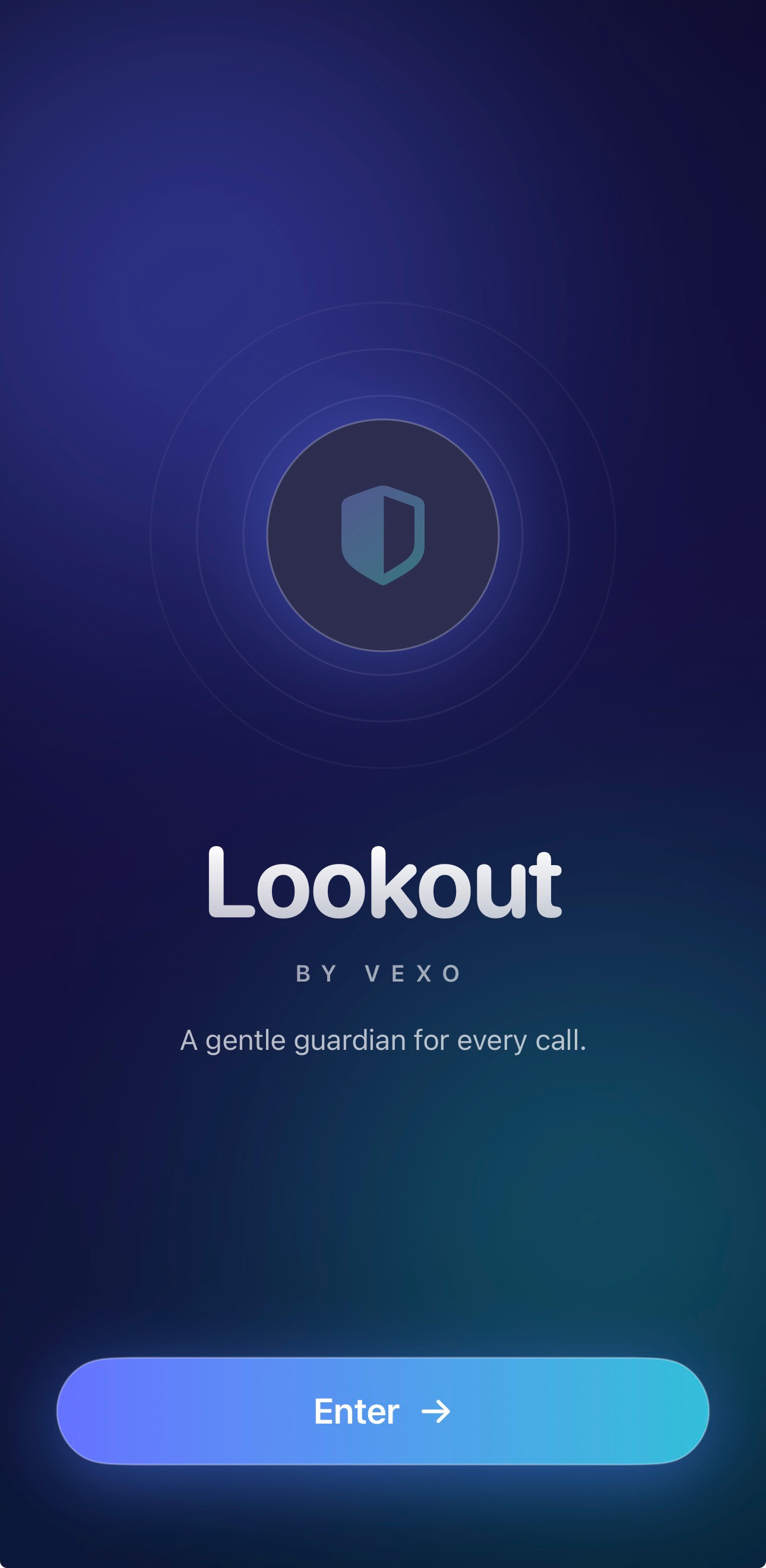
The app, running today
These screens are from the Swift app built for this hackathon and running on iPhone. This is the live demo, not a mock up: watch the risk climb as each new line of the call lands.
A calm start
Lookout by VEXO opens as a gentle guardian for every call, listening quietly in the background.
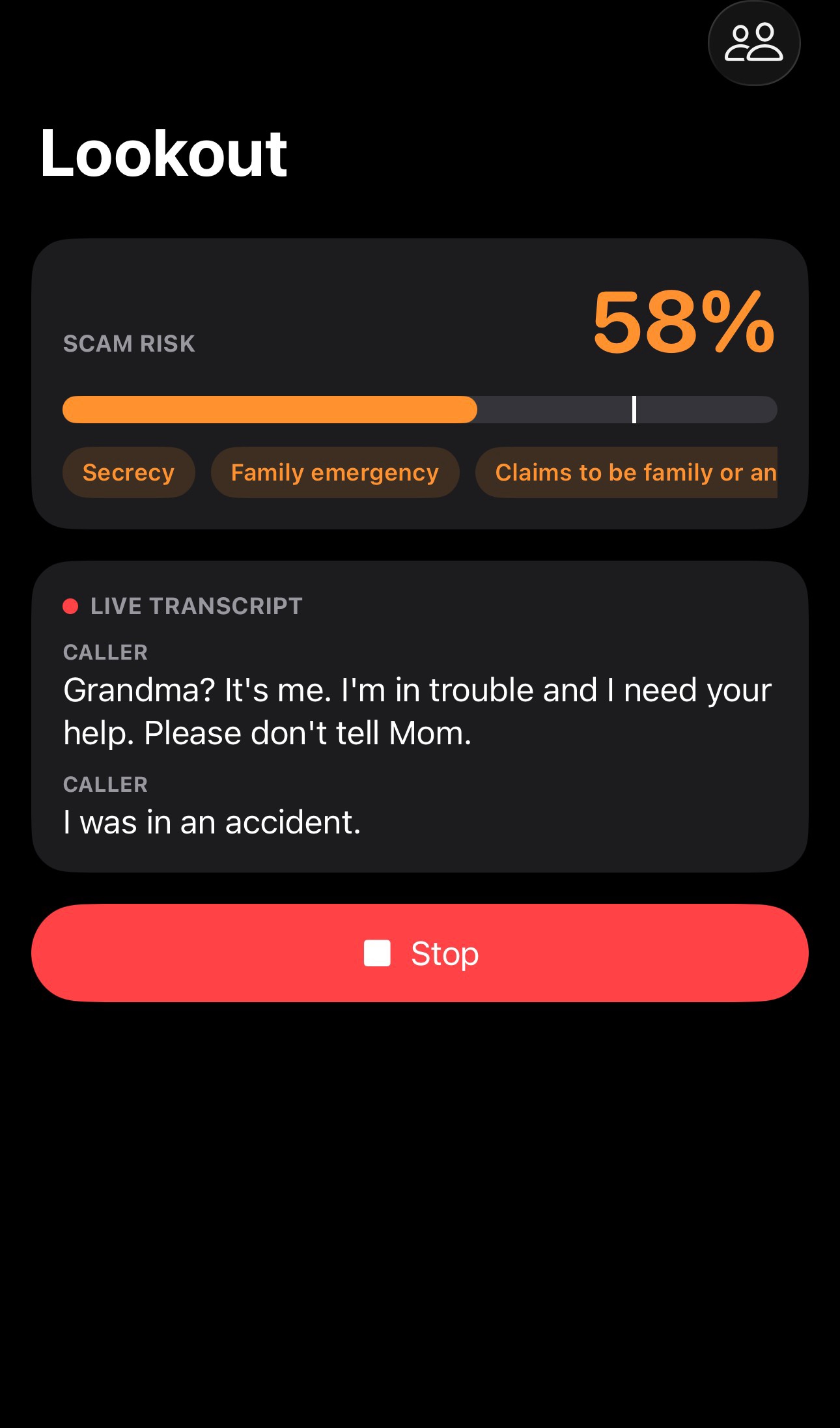
The risk climbs
Two lines in, the score already reads 58 percent. Secrecy and family emergency chips light up in amber.
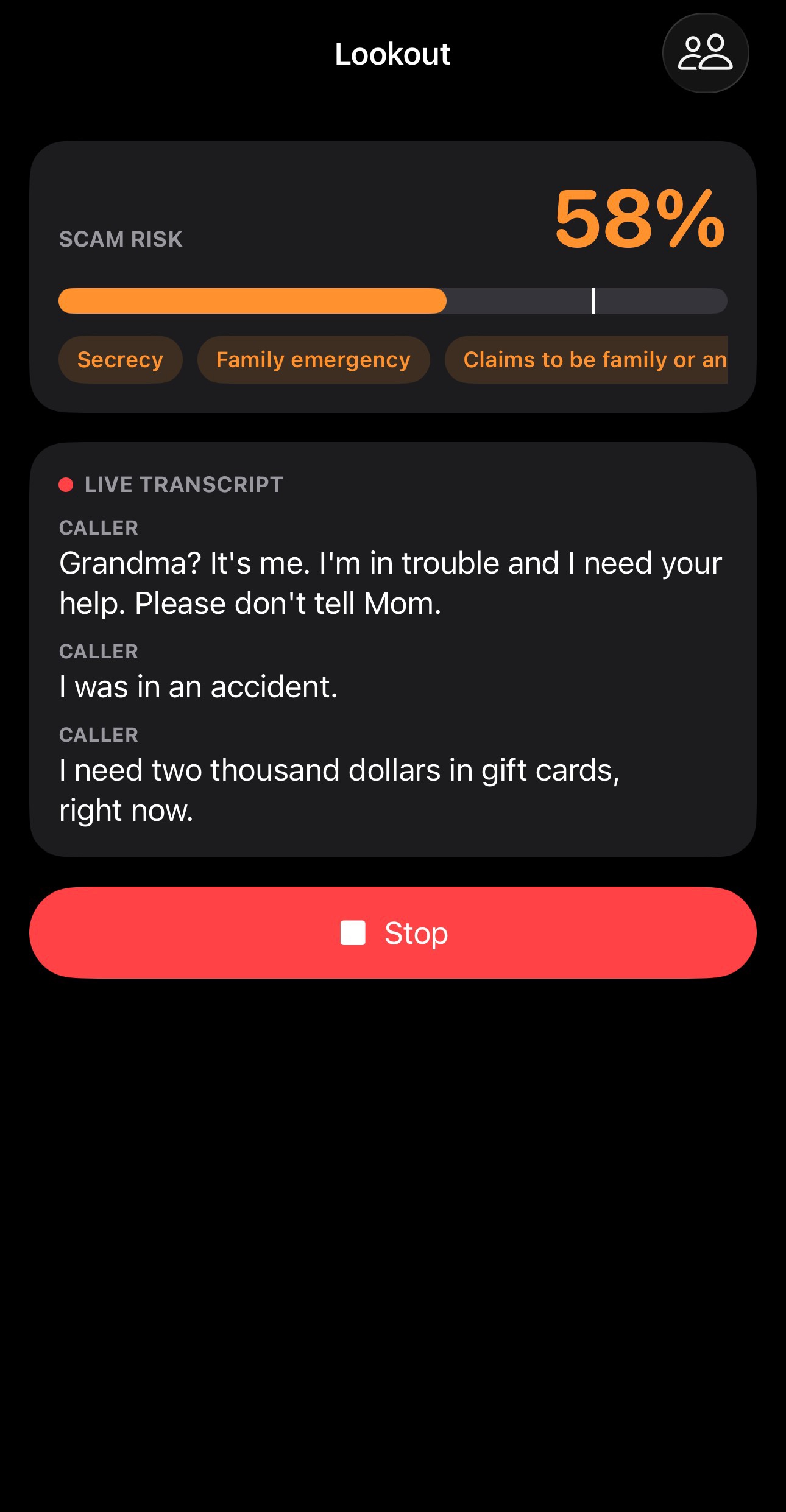
Every word, scored
The live transcript grows line by line while the app weighs each phrase the caller uses.
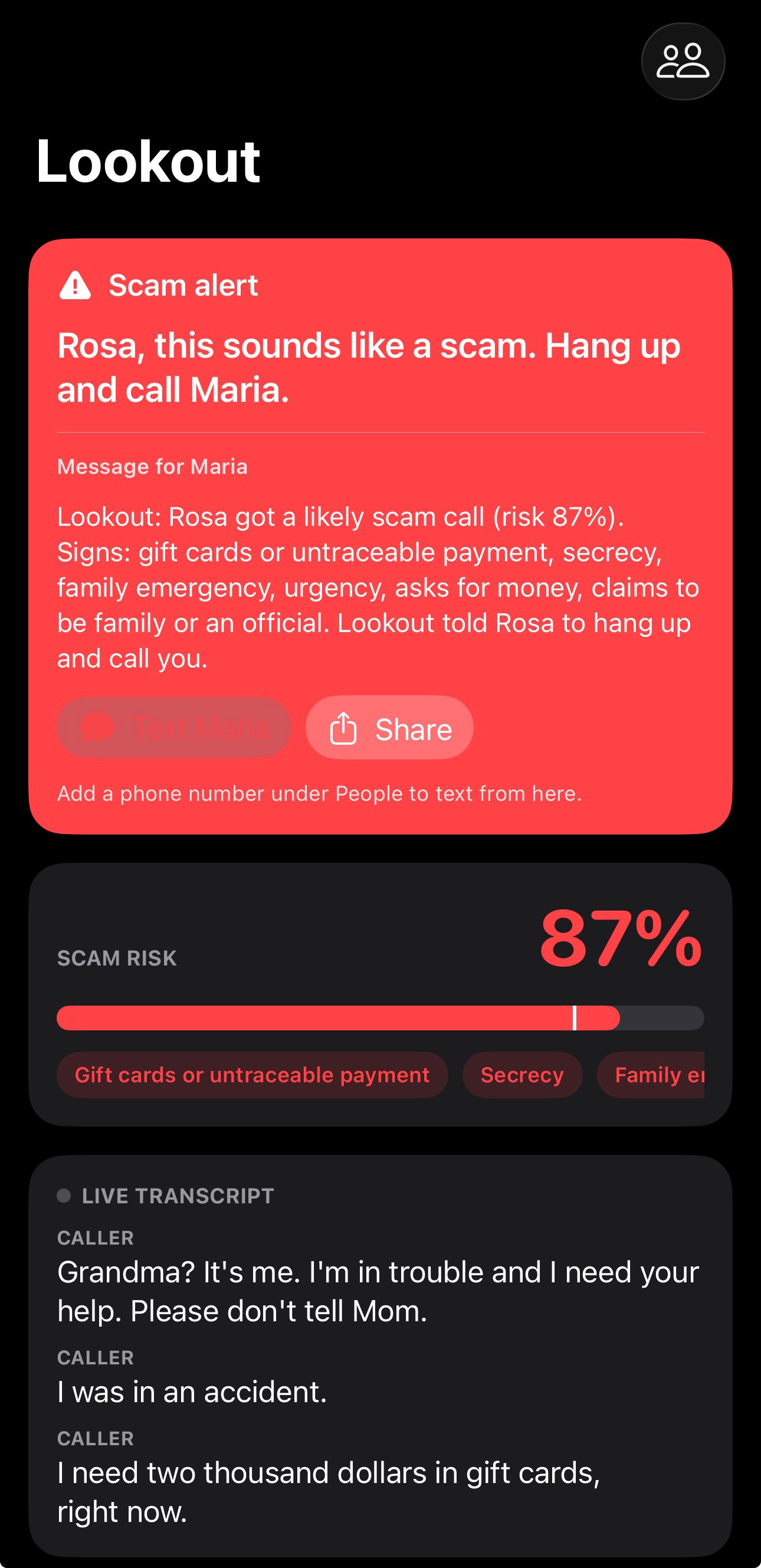
The alert lands
At 87 percent the screen turns red. Rosa is told to hang up and call Maria, and the family message is already written.
The concept film
Fifty one seconds on why this has to live on the wrist. At the grocery store, Rosas phone sits buried in her purse and its alert goes unseen. The bracelet is on her body, and its warning cannot be missed the same way.
How the scoring works
The app listens for the pressure pattern that every family emergency scam shares, and it needs several signals together before it will interrupt a call.
Listen and transcribe
Call audio streams to Deepgram, and the live transcript lands line by line, so every claim the caller makes can be weighed as it is spoken.
Score the signals
Each danger signal adds weight to the score. One odd phrase never fires the alert on its own.
Warn, then tell family
Past the line, the wearer gets one clear instruction, and family receives a plain summary of what was claimed and what was demanded.
Powered by Deepgram
Lookout hears through Deepgram. Its streaming speech to text is the front door of the whole engine: no transcript, no scoring, no alert.
Live transcription
Call audio streams to Deepgram and comes back as text while the caller is still speaking. Interim results let the risk gauge move on the first sentence, not after the call ends.
Word level confidence
Deepgram attaches a confidence score to every word. That score is r, the reliability term in the formula below, so clear threats count for more than garbled guesses.
Tuned to the scam
Diarization keeps Rosa and the caller in separate lanes, so her words never score against her. Keyterm boosting sharpens the ear for gift cards, wire transfer, and secrecy phrases.
Inside the engine: the Gemini decision matrix
The Gemini API runs the decision layer. Trigger words are scored for how reliable they are as evidence of a scam, and every signal is then counted against four pieces of context: the time of day, who is calling, the information the caller has, and what the caller is asking for.
| Signal | Trigger phrases | Weight w |
|---|---|---|
| Claims to be family or an official | “Grandma, it’s me”, “this is the police”, “your grandson” | 0.24 |
| Family emergency | accident, hospital, jail, stranded, hurt | 0.20 |
| Secrecy | “don’t tell Mom”, “keep this between us” | 0.16 |
| Urgency | right now, immediately, before it is too late | 0.16 |
| Asks for money | cash demands of any kind | 0.20 |
| Gift cards or untraceable payment | gift cards, crypto, wire transfer, cash pickup | 0.32 |
Gift card demands weigh the most on purpose. Real family in real trouble almost never asks to be paid in gift cards.
| Context factor | Question it answers | Scale |
|---|---|---|
| Time of day, τ | When is this call arriving? | Day 1.00 · Evening 1.10 · Late night 1.20 |
| Who is calling, κ | Can this number be trusted? | Verified family 0.50 · Known 0.85 · Unknown 1.00 · Unknown claiming family 1.25 |
| Information they have, ι | How much do they know about this family? | Nothing personal 0.90 · Names 1.00 · Names plus private details 1.15 |
| What they ask for, α | How traceable is the payment? | Payment signals only: normal 1.00 · Cash pickup 1.10 · Gift cards, crypto or wire 1.20 |
After two lines
Claims family 0.30, secrecy 0.20, family emergency 0.25. R = 100 × (1 − 0.70 × 0.80 × 0.75) = 100 × (1 − 0.42). The caller factor 1.25 is already inside each p, for an unknown number claiming to be family.
The full call
Urgency 0.20, asks for money 0.25, and gift cards 0.48 join in, the last one lifted by the 1.20 ask factor. R = 100 × (1 − 0.42 × 0.80 × 0.75 × 0.52), across the 70 line, and the alert fires.
The moment it matters
This is the exact alert the app shows Rosa, and the exact message it prepares for her daughter.
What the caller said
that remembers and acts.
Lookout is a working proof of concept built at VexoHacks, the AI wearables hackathon at Y Combinator in San Francisco, on Nov 14, 2026, by Christopher Guerrero of Apex Studio LLC. Decisions run on the Gemini API, and the app was built with Google Carbon.
Light version of this page: classic landing page